Contents
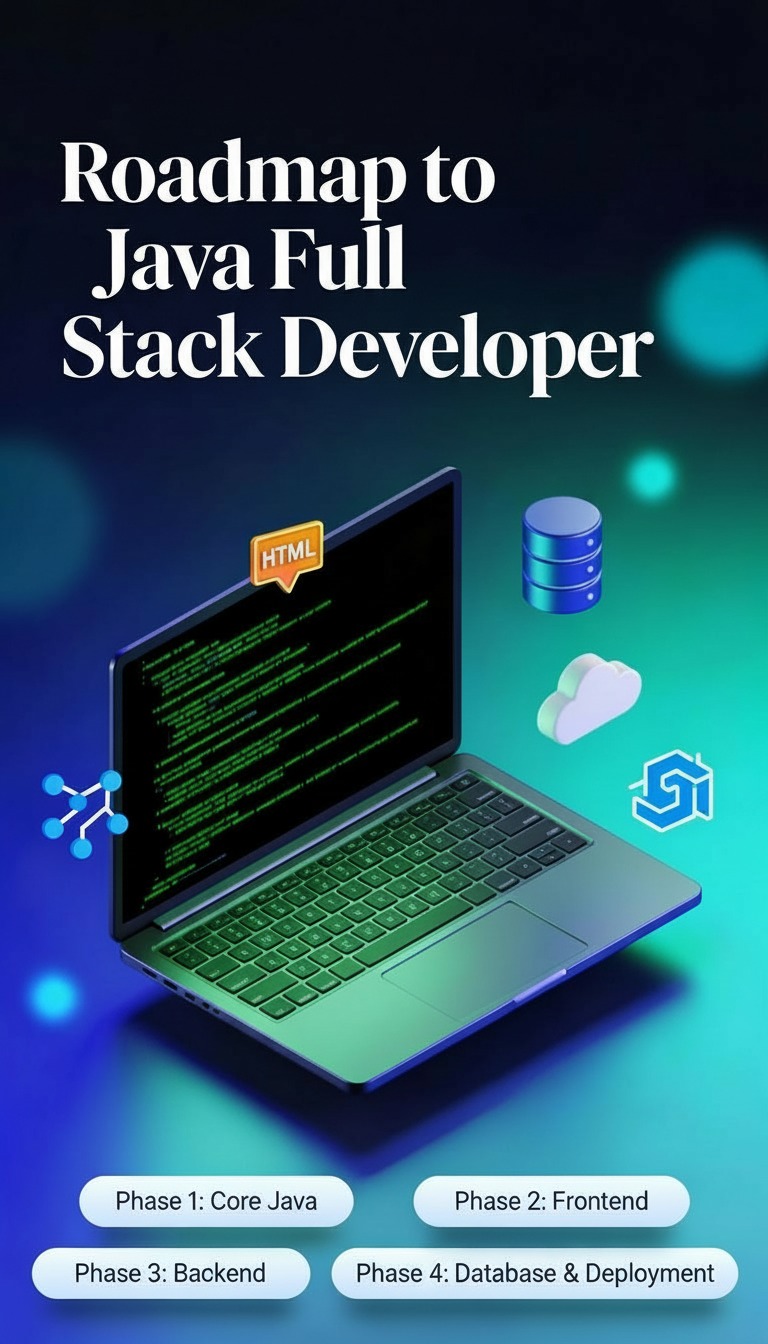
Java Roadmap 2026 is your complete guide to becoming a Full Stack Java Developer. In this step-by-step roadmap, we cover everything from Java basics to advanced frameworks and tools.The demand for Java Full Stack Developers continues to grow as companies increasingly rely on web-based and enterprise applications. Planning a career in software development requires a clear learning structure. ..Organizations today prefer professionals who can work across the entire application lifecycle, from designing user interfaces to developing backend services and managing databases.
For students and working professionals planning a career in software development, understanding the Java Full Stack Developer roadmap is the first and most important step. This Blog explains what skills are required, why they matter, and how to learn them in the right sequence to become job-ready.
What Is a Java Full Stack Developer?
A Java Full Stack Developer is a software professional who works on both the frontend and backend of an application using Java-based technologies. They are responsible for building complete web applications, integrating databases, creating APIs, and deploying applications on servers or cloud platforms.
Most companies look for developers who can:
- Design responsive user interfaces
- Write secure and scalable backend logic
- Connect applications with databases
- Build and consume REST APIs
- Deploy and maintain applications
This combination of skills makes Java Full Stack Developers highly valuable in the IT industry.By following a proven Java Full Stack Developer Roadmap, learners can avoid common mistakes and focus on industry-relevant technologies.
Why Is Java Full Stack Development a Smart Career Choice?
Java has been a trusted programming language for decades and is widely used in enterprise systems, banking applications, e-commerce platforms, and large-scale web applications.
Key reasons why Java Full Stack development is a strong career choice include:
- High demand across industries
- Long-term career stability
- Opportunities in startups and MNCs
- Competitive salary packages
- Wide ecosystem of frameworks and tools
Understanding the Java full stack career path helps learners choose the right skills and roles at each stage.For those aiming to build a future-proof IT career, Java Full Stack development offers both growth and security
Java Full Stack Developer Roadmap: Step-by-Step Learning Guide
This Java full stack development roadmap focuses on building both frontend and backend skills required by employers.
Understanding the Java full stack career path helps learners plan their growth from beginner to professional roles.
Step 1: Learn Core Java Fundamentals
Core Java forms the foundation of the entire roadmap. Without a strong understanding of Java basics, it becomes difficult to work with advanced frameworks and real-time applications.
Important topics include:
- Java syntax and fundamentals
- Object-oriented programming concepts
- Classes, objects, inheritance, polymorphism
- Exception handling
- Collections framework
- Multithreading basics
- Java 8 features
.A clear understanding of these concepts helps developers write clean, efficient, and maintainable code.
Step 2: Advance Java and Backend Development
After mastering Core Java, the next stage focuses on server-side development. This is where applications handle business logic, data processing, and communication with databases.
Key backend technologies to learn:
- JDBC for database connectivity
- Servlets and JSP
- MVC architecture
- Spring Framework
- Spring Boot
- RESTful web services
- Microservices fundamentals
Backend skills are essential for building scalable and enterprise-level applications used in real-world environments.This phase is a critical part of the Java full stack development roadmap followed by most professional developers.
Step 3: Frontend Development Skills
A Java Full Stack Developer must also be capable of building interactive and user-friendly interfaces. Frontend development ensures that applications are visually appealing and easy to use.
Core frontend technologies include:
- HTML for structure
- CSS for styling
- JavaScript for interactivity
- Responsive web design
- Modern UI frameworks such as React or Angular
Understanding frontend development allows developers to work closely with designers and deliver complete solutions.Frontend skills play an important role in the overall Java full stack career path of a developer.
Step 4: Database and SQL Knowledge
Every web application relies on data. Learning how to store, retrieve, and manage data efficiently is a critical part of the roadmap.
Essential database skills include:
- SQL queries and joins
- Database design concepts
- MySQL or Oracle databases
- CRUD operations
- Performance optimization basics
Strong database knowledge improves application reliability and performance.
Step 5: Version Control and Build Tools
Professional development environments require collaboration and proper code management.
Important tools to learn:
- Git and GitHub
- Maven or Gradle
- Basic understanding of CI/CD workflows
These tools are commonly used in real-time projects and are often expected in technical interviews.
Step 6: Deployment and Cloud Basics
Modern applications are deployed on cloud platforms rather than traditional servers. Understanding deployment helps developers take applications from development to production.
Recommended skills include:
- Linux fundamentals
- Application deployment concepts
- Cloud computing basics
- Working knowledge of AWS, Azure, or Google Cloud
This knowledge adds significant value to a Java Full Stack profile
Step 7: Real-Time Projects and Practical Experience
Practical exposure is what transforms a learner into a professional. Working on real-time projects helps in understanding how applications are built, tested, and deployed in actual industry environments.
Projects help in:
- Strengthening technical confidence
- Building a strong resume
- Understanding real-world challenges
- Performing better in interviews
Hands-on training with mentor support plays a crucial role at this stage.
Step 8: Interview Preparation and Job Assistance
The final step in the roadmap is preparing for job interviews and placements.
This includes:
- Resume building
- Core Java and framework interview questions
- Coding practice
- Mock interviews
- Technical and HR round preparation
A well-defined Java Full Stack Developer Roadmap helps learners gain confidence, practical experience, and long-term career stability.Structured placement support helps candidates transition smoothly into professional roles.
Frequently Asked Questions
1.Is Java Full Stack development suitable for freshers?
Ans-Freshers with proper training, hands-on practice, and project experience can successfully start their careers as Java Full Stack Developers.
2.Do I need prior coding knowledge?
Ans-Basic programming knowledge helps, but many learners start from scratch with proper guidance and structured training.
3.Is Java Full Stack development still in demand?
Ans-Yes. Java continues to be widely used in enterprise applications, making Full Stack Java developers consistently in demand.
4.Can I learn Java Full Stack online?
Ans-Yes. Online training combined with live sessions, mentor support, and practical labs can be as effective as classroom learning.
5.How to become a Java full stack developer?
Ans-To understand how to become a Java full stack developer, learners should follow a structured approach covering Java, frontend frameworks, backend technologies, and real-time projects.
- Click here for Java Full Stack Course