Contents
Introduction
Python full-stack development has become one of the most in-demand career paths in the software industry. Companies today prefer developers who can manage both the frontend and backend of web applications efficiently. A Python full-stack developer fits this requirement perfectly by combining user interface development, server-side programming, database handling, and application deployment skills.
This article explains the essential skills required to become a Python full-stack developer, why these skills matter in real projects, and how learners can build a strong foundation for long-term career growth.
What Does a Python Full-Stack Developer Do?
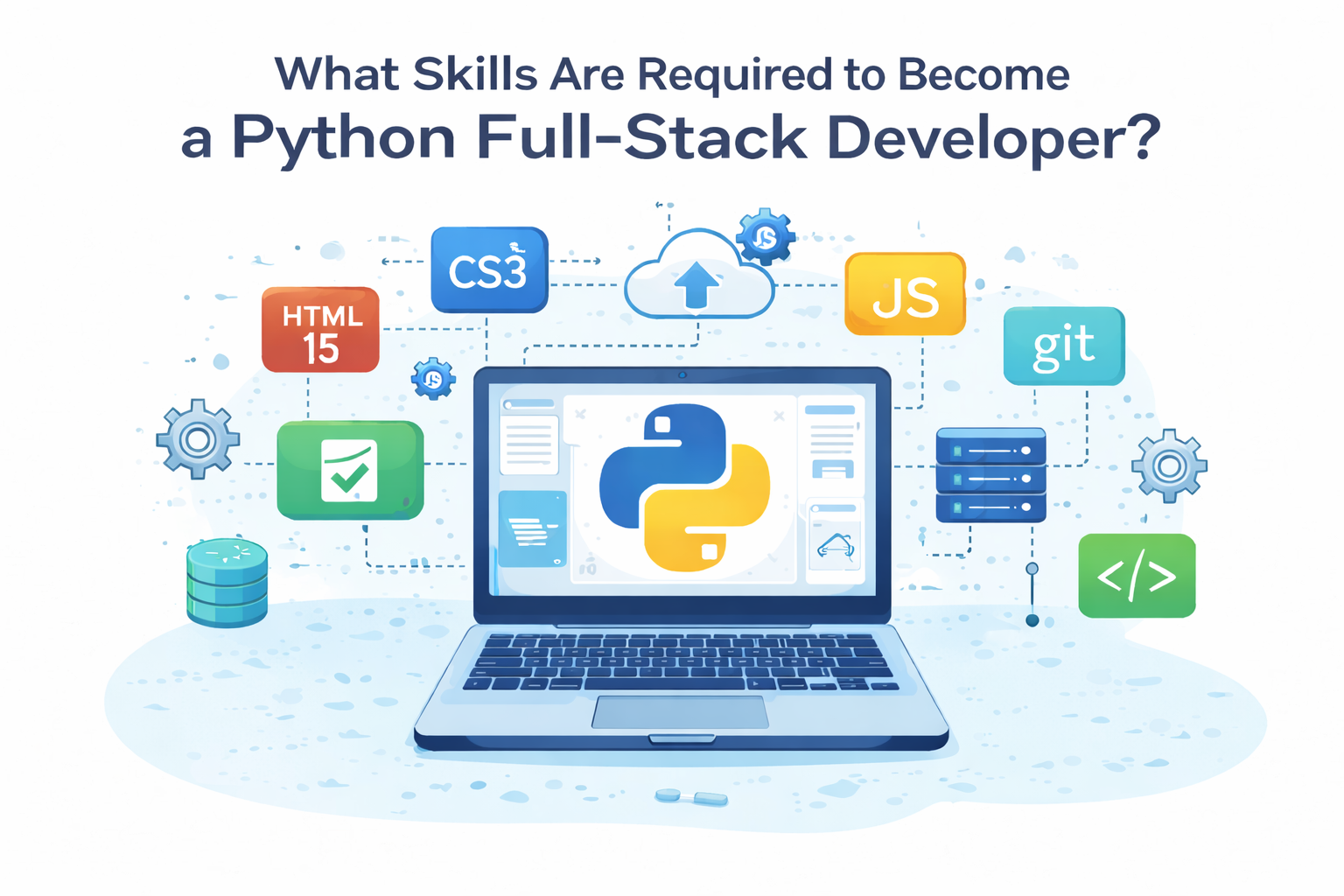
A Python full-stack developer is responsible for developing complete web applications. This includes designing the user interface, writing backend logic using Python, managing databases, building APIs, and deploying applications on servers or cloud platforms.
Instead of working on a single layer, full-stack developers understand how all parts of an application work together, which makes them highly valuable in the job market.
Why Are Python Full-Stack Developers in High Demand?
Python is widely used because it is easy to learn, highly scalable, and supported by a large ecosystem of frameworks and libraries. Businesses across domains such as finance, healthcare, e-commerce, and technology services rely on Python-based applications.
Organizations prefer Python full-stack developers because they:
- Reduce dependency on multiple specialists
- Speed up application development
- Handle end-to-end project requirements
- Adapt easily to new technologies
Who Can Learn Python Full-Stack Development?
Python full-stack development is suitable for:
- Fresh graduates starting a software career
- Students from technical and non-technical backgrounds
- Backend or frontend developers upgrading skills
- Working professionals aiming for better job roles
- Individuals planning to switch careers into IT
No advanced programming background is required to begin.
Essential Skills Required to Become a Python Full-Stack Developer
1. Python Programming Skills
Python is the core language used for backend development. A strong understanding of Python helps in writing efficient and maintainable code.
Key concepts include:
- Variables, data types, and operators
- Conditional statements and loops
- Functions and modules
- Object-oriented programming concepts
- Exception handling and file operations
2. Frontend Development Skills
Frontend skills are required to create visually appealing and user-friendly interfaces.
Important frontend technologies:
- HTML for structuring web pages
- CSS for styling and responsive layouts
- JavaScript for dynamic behavior
- Modern CSS frameworks for faster UI development
- Basic knowledge of frontend libraries for interactive applications
3. Backend Development Using Python Frameworks
Backend development manages application logic and data flow.
Popular Python frameworks include:
- Django for full-scale web applications
- Flask for lightweight and flexible development
- FastAPI for high-performance API-based systems
Backend skills include:
- URL routing and request handling
- Authentication and authorization
- Form handling and validation
- Session and security management
4. Database and Data Management Skills
Web applications depend heavily on data storage and retrieval.
Databases commonly used:
- Relational databases such as MySQL or PostgreSQL
- Basic understanding of NoSQL databases
Core concepts:
- Database design and normalization
- Writing queries and joins
- Performing CRUD operations
- Using ORM tools for database interaction
5. API Development and Integration
APIs allow communication between frontend, backend, and external services.
Skills required:
- Designing RESTful APIs
- Working with JSON data
- Implementing authentication mechanisms
- Integrating third-party services
6. Version Control and Collaboration Tools
Version control systems are essential in real-time development environments.
Developers should know how to:
- Track code changes
- Work with branches
- Collaborate with teams
- Manage repositories efficiently
7. Deployment and Basic Cloud Knowledge
Python full-stack developers often participate in deploying applications.
Key areas include:
- Linux fundamentals
- Web servers and hosting basics
- Application deployment process
- Introductory cloud computing concepts
8. Testing and Debugging Skills
Testing ensures application stability and performance.
Important aspects:
- Writing unit tests
- Debugging runtime issues
- Handling errors gracefully
- Improving application reliability
9. Problem-Solving and Professional Skills
Beyond technical skills, developers need:
- Analytical thinking
- Logical problem-solving ability
- Clear communication skills
- Team collaboration experience
- Willingness to learn continuously
How Long Does It Take to Become Job-Ready?
With structured learning and hands-on practice, most learners can become job-ready within 6 to 8 months. Real-time projects, mentorship, and placement-focused training significantly reduce the learning curve.
Career Opportunities After Learning Python Full-Stack
Python full-stack developers can work as:
- Full-Stack Web Developers
- Python Developers
- Backend Engineers
- Software Developers
- Application Developers
These roles are available across startups, enterprises, and global IT companies.
Python full-stack development is a powerful skill set that combines frontend design, backend logic, database management, and deployment knowledge. Learning these skills opens doors to diverse career opportunities in the software industry. With the right guidance, structured training, and hands-on exposure, aspiring developers can build a stable and rewarding career as Python full-stack professionals.
Frequently Asked Questions
1.Is Python full-stack development suitable for beginners?
Ans-Yes, Python’s simple syntax makes it ideal for beginners and fresh graduates.
2.Do I need prior programming experience?
Ans-No prior experience is required. The course starts from fundamentals.
3.Which Python framework is best for full-stack development?
Ans-Django is widely used for complete web applications, while Flask and FastAPI are preferred for flexible and API-based development.
4.Does Python full-stack development have long-term scope?
Ans-Yes, Python continues to grow across industries, making full-stack developers highly relevant.
5.Can I get a job after completing Python full-stack training?
Ans-With proper training, project experience, and placement support, learners have strong job opportunities.
- Click here for Python full Stack Course