Contents
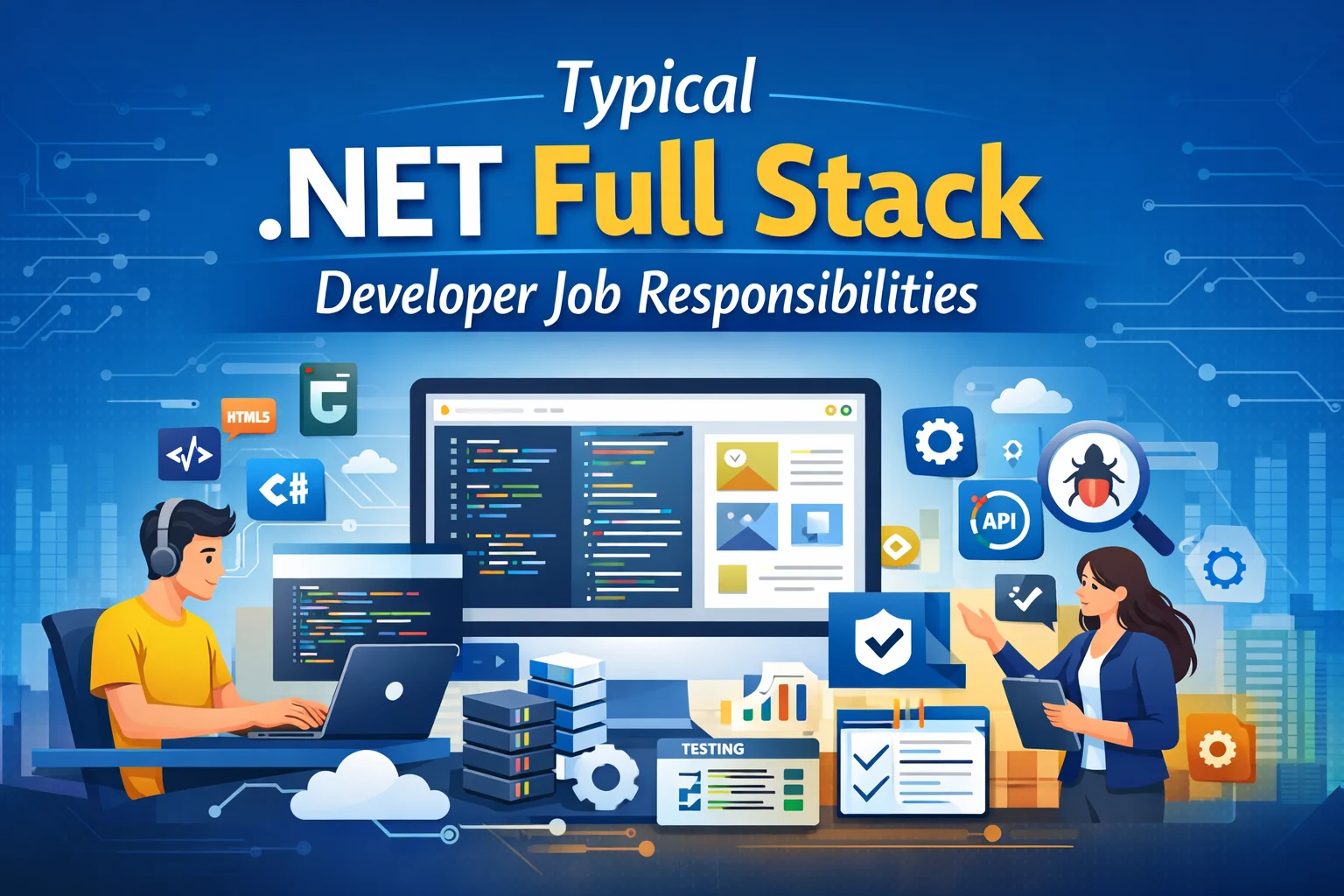
Full Stack .NET roles often attract freshers who feel confident after training but still remain unsure about what actually happens inside a company after joining as a junior developer.
In reality, the job is not about knowing everything. It is about handling small responsibilities correctly and learning how real applications are built in a team environment.
This is why understanding real Full Stack .NET job responsibilities is important for freshers entering the IT industry.
What Does “Entry-Level” Really Mean in a .NET Role?
At the entry level, companies do not expect freshers to design entire systems or make architecture decisions. Instead, they expect basic clarity in .NET fundamentals and the ability to support ongoing development work.
Most junior developers work closely with senior developers, testers, and team leads. The learning happens daily while working on live tasks, not just during training.
Why Companies Prefer Entry-Level Full Stack .NET Developers
Organizations hire entry-level full stack .NET developers because they want professionals who can gradually grow into multiple responsibilities. A fresher who understands both UI and backend logic becomes more useful over time compared to someone limited to only one area.
Another reason is adaptability. Junior developers usually adapt faster to company standards, coding practices, and project workflows.
Typical Full Stack .NET Developer Job Responsibilities
Front-End Work in Real Projects
Most beginners assume front-end work means heavy design, but that is rarely the case at entry level. Instead, responsibilities usually include:
- Updating existing pages rather than creating new designs
- Fixing alignment, spacing, or responsiveness issues
- Connecting UI elements with backend data
- Making small JavaScript changes based on requirements
This kind of work helps new developers understand how user actions connect with server-side logic.
Back-End Responsibilities in Day-to-Day Work
Backend tasks are usually assigned in small pieces. Entry-level full stack .NET developers often work on:
- Writing simple C# methods
- Modifying existing ASP.NET or ASP.NET Core code
- Handling form submissions and validations
- Supporting API integration work
- Fixing backend bugs identified during testing
All changes are reviewed before going live, which helps beginners learn best practices naturally.
Working with Databases as a Fresher
Database work is unavoidable in .NET projects. At the junior level, responsibilities usually include:
- Writing basic SELECT, INSERT, UPDATE queries
- Understanding how tables are connected
- Fixing data-related issues in applications
- Using Entity Framework to fetch and save data
This is where many freshers start understanding how applications actually store and use information.
Testing and Bug Fixing Responsibilities
One of the most common responsibilities for entry-level developers is bug fixing. This includes:
- Debugging errors reported by testers
- Reproducing issues and identifying root causes
- Fixing logic errors in code
- Supporting minor changes after deployment
Though it may feel repetitive, this phase builds strong problem-solving skills.
Team-Level Responsibilities Beyond Coding
Entry-level full stack .NET developer job responsibilities are not limited to writing code. Developers are also expected to:
- Attend daily meetings
- Update task progress
- Follow project coding standards
- Use version control tools properly
- Learn how deployments and releases work
These habits matter a lot in professional environments.
Skills That Make Entry-Level Developers Perform Better
Freshers who handle responsibilities smoothly usually have:
- Clear understanding of C# fundamentals
- Practical knowledge of ASP.NET MVC or ASP.NET Core
- Basic front-end skills
- SQL Server knowledge
- Willingness to ask questions and learn
Hands-on practice always matters more than theoretical knowledge.
Career Growth After Entry-Level .NET Development Experience
After gaining experience, developers slowly move from fixing issues to building features. Over time, they start handling modules independently and contribute to design discussions. This gradual exposure is what shapes a strong .NET professional.
Common Questions from Freshers
1. What is the first task usually assigned to an entry-level .NET developer?
Most freshers start with bug fixes, UI updates, or small backend changes under supervision.
2. Is it stressful for beginners?
Initially, it can feel challenging, but proper guidance and training make the transition smooth.
3. Do companies expect real project knowledge from day one?
No. Companies expect basic understanding and learning ability, not perfection.
4. Is full stack knowledge really useful at entry level?
Yes, because it helps developers understand the complete application flow.
NareshIT – Delivering quality software training for over a decade. Empower your future with job-oriented courses and practical sessions
Click here for .NET Full Stack Course