Contents
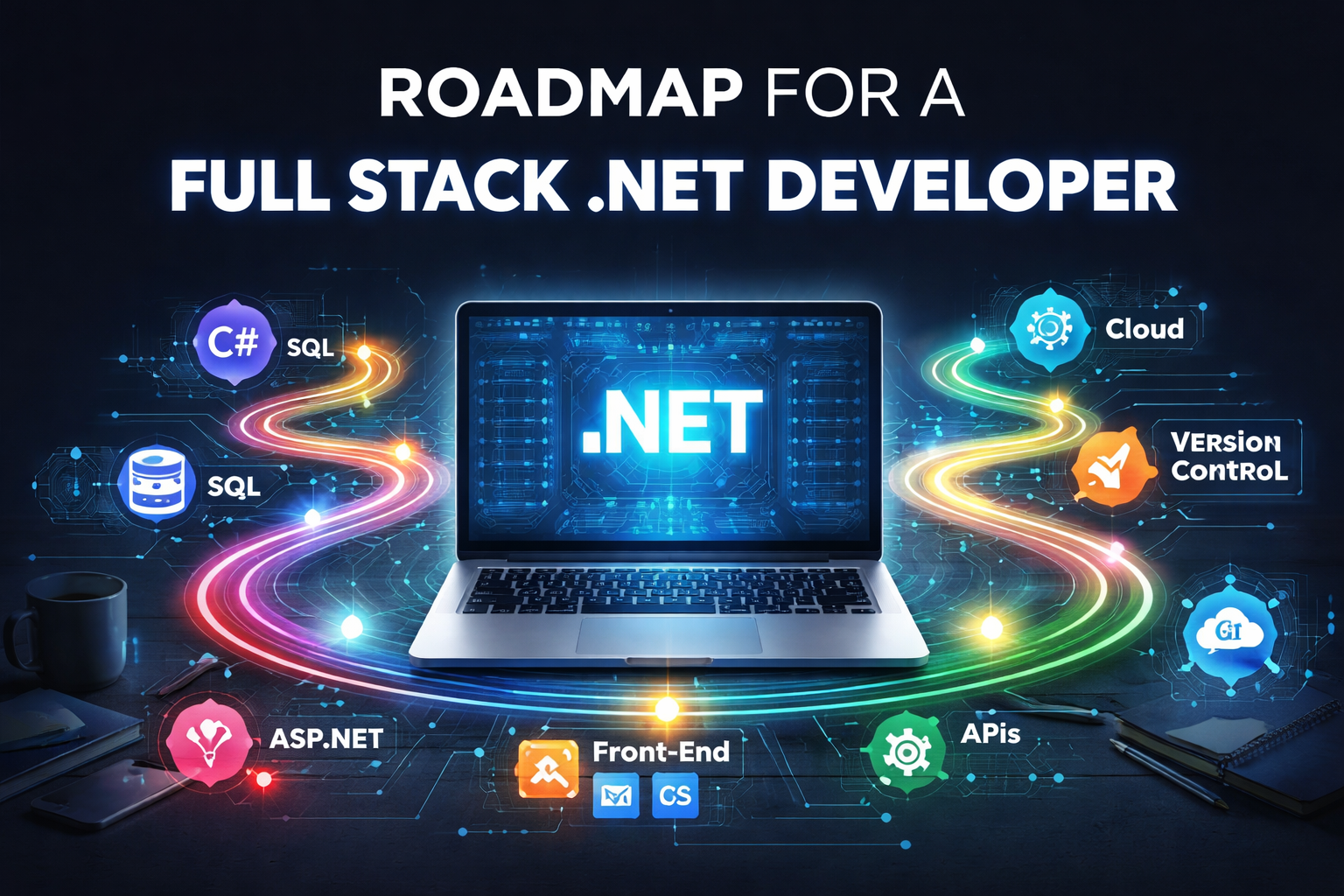
The Full Stack .NET Developer Roadmap is a step-by-step guide that helps aspiring developers learn frontend, backend, databases, and deployment using Microsoft’s .NET ecosystem. Whether you are a fresher or switching careers, this roadmap clearly explains the skills, tools, and technologies required to become a job-ready Full Stack .NET Developer.The demand for Full Stack .NET Developers has grown steadily as organizations look for professionals who can handle both front-end and back-end development efficiently. A clear learning roadmap helps students and professionals understand what to learn, in what order, and how to prepare for real-world software development roles.This guide explains the complete roadmap for becoming a Full Stack .NET Developer, covering essential skills, tools, technologies, and career preparation steps required to succeed in today’s IT industry.
What Does a Full Stack .NET Developer Do?
A Full Stack .NET Developer is responsible for designing, developing, testing, and maintaining complete web applications. This role involves working on user interfaces, server-side logic, databases, and application deployment using Microsoft’s .NET ecosystem.
Key responsibilities include:
- Developing interactive front-end applications
- Writing server-side logic using .NET technologies
- Managing databases and data flow
- Building and consuming APIs
- Deploying and maintaining applications
Why Is Full Stack .NET a Good Career Choice?
Full Stack .NET development is widely adopted in enterprise-level applications due to its stability, scalability, and security. Many organizations prefer .NET for long-term projects, making it a reliable career option.
Major reasons to choose this path include:
- Strong demand in the software job market
- Long-term relevance of .NET technologies
- Opportunities across multiple industries
- Suitable for both freshers and experienced professionals
- Clear growth path from developer to architect roles
Who Should Learn Full Stack .NET?
This roadmap is suitable for:
- Fresh graduates looking to enter the IT industry
- Students pursuing computer science or related fields
- Working professionals planning a career transition
- Developers aiming to upgrade their technical skills
No advanced technical background is required to start, as the learning begins from fundamentals.
When Is the Right Time to Start Learning Full Stack .NET?
With the continuous evolution of web and cloud technologies, companies are actively hiring skilled Full Stack .NET Developers. Starting early helps learners gain hands-on experience and stay aligned with industry requirements.
Those who begin learning now can prepare themselves for upcoming job opportunities by acquiring practical and project-based skills.
Full Stack .NET Developer Roadmap (Step-by-Step)
1. Programming Fundamentals
The first step is building a strong foundation in programming concepts:
- C# programming basics
- Object-oriented programming principles
- Variables, data types, loops, and conditions
- Exception handling and collections
This stage helps learners develop logical thinking and problem-solving skills.
2. Front-End Development Skills
Front-end technologies are essential for building user-friendly applications:
- HTML and CSS for structure and styling
- JavaScript for dynamic behavior
- Responsive design concepts
- UI frameworks for faster development
Understanding front-end development improves collaboration between design and development teams.
3. Back-End Development with .NET
This is the core of the Full Stack .NET roadmap:
- ASP.NET fundamentals
- MVC architecture
- ASP.NET Core concepts
- Web API development
- Authentication and authorization
Back-end development focuses on business logic, performance, and security.
4. Database Management
Every application relies on efficient data handling:
- SQL Server fundamentals
- Database design concepts
- Writing queries and stored procedures
- Data manipulation and optimization
A solid understanding of databases is essential for real-time project development.
5. Development Tools and Version Control
Professional developers use tools to manage code efficiently:
- Integrated development environments
- Version control systems
- Debugging and testing techniques
- Code optimization practices
These skills are crucial in collaborative work environments.
6. Deployment and Industry Practices
To become job-ready, learners must understand:
- Application deployment basics
- Hosting and maintenance concepts
- Performance tuning
- Security best practices
This stage bridges the gap between learning and real-world implementation.
7. Real-Time Projects and Job Preparation
Hands-on experience is the key to employment:
- Real-time project implementation
- Industry-specific use cases
- Resume building
- Interview preparation
- Dedicated placement support
Practical exposure significantly improves confidence and employability.
How Long Does It Take to Become a Full Stack .NET Developer?
The learning duration depends on individual dedication and practice:
- Basic understanding: 2–3 months
- Job-oriented skills: 5–6 months
- Advanced proficiency with projects: 8–9 months
Structured training with mentor support accelerates the learning process.
Career Opportunities After Full Stack .NET Training
After completing the roadmap, learners can apply for roles such as:
- Full Stack .NET Developer
- ASP.NET Developer
- Software Engineer
- Backend Developer
- Web Application Developer
These roles are available across IT services, enterprise solutions, and product-based companies.
The roadmap for a Full Stack .NET Developer provides a clear and structured path for anyone aiming to build a successful career in software development. By learning the right technologies in the correct sequence and gaining real-time project experience, learners can confidently enter the IT industry.Choosing a training approach that focuses on practical learning, industry-specific scenarios, and placement preparation makes a significant difference in achieving long-term career success.
Frequently Asked Questions
1.Is Full Stack .NET suitable for beginners?
Ans-Yes, beginners can start from scratch by learning programming fundamentals and gradually progressing to advanced topics.
2.Does Full Stack .NET have long-term career scope?
Ans-Yes, .NET technologies are widely used in enterprise applications, ensuring long-term career stability.
3.Are projects important for learning Full Stack .NET?
Ans-Yes, real-time projects help learners understand industry requirements and improve job readiness.
4.Can non-IT graduates learn Full Stack .NET?
Ans-With proper guidance and consistent practice, non-IT graduates can successfully build a career in this field.
Click here for Full Stack .NET Course