Contents
Introduction:
Cloud computing is a technology that allows businesses and individuals to access servers, storage, databases, networking, and software over the internet.
Instead of maintaining physical hardware, organizations use cloud-based systems to build scalable, flexible, and cost-effective digital solutions. These platforms support modern digital services such as mobile applications, online storage, artificial intelligence, and business automation.
Why Is Cloud Computing Important Today?
Cloud adoption has grown rapidly because it solves many challenges that traditional IT systems could not. Some reasons why it is so important today include:
- It reduces the cost of owning and maintaining hardware.
- It allows companies to scale instantly during high demand.
- It keeps data safe with advanced security and backup systems.
- It supports modern technologies like AI, DevOps, data analytics, and automation.
- It enables global access so teams can work from anywhere.
- It helps businesses launch applications quickly without delays.
The combination of speed, reliability, and flexibility is the main reason why cloud-based platforms have become a core part of digital transformation.
Who Uses Cloud Technology?
Cloud computing is used by almost every sector today. Some of the major users include:
- IT companies
- Startups and small businesses
- Banks and financial institutions
- Healthcare and pharmaceutical companies
- E-commerce platforms
- Media and entertainment firms
- Government and education sectors
- Manufacturing and logistics companies
Students, working professionals, and career-changers also rely on cloud tools to learn, experiment, and build projects.
When Do Organizations Use Cloud Services?
These cloud-based services help organizations manage workloads efficiently while supporting scalability and security.
- On-demand storage without buying physical drives
- High-performance servers for application development
- Large-scale data processing
- Backup and disaster recovery
- Continuous deployment pipelines
- Virtual machines for development and testing
- Secure data management for compliance requirements
Cloud adoption usually increases when a company expands, modernizes its systems, or needs faster innovation.
Where Is Cloud Computing Used?
Cloud technology is present in almost every system we use daily. Some common areas include:
- Mobile and web applications
- Online banking and payment systems
- Streaming platforms
- Email services
- Navigation and mapping tools
- Online learning platforms
- Enterprise software
- IoT devices and smart appliances
This wide usage makes cloud computing one of the most relevant technologies for the future.
How Does Cloud Computing Work?
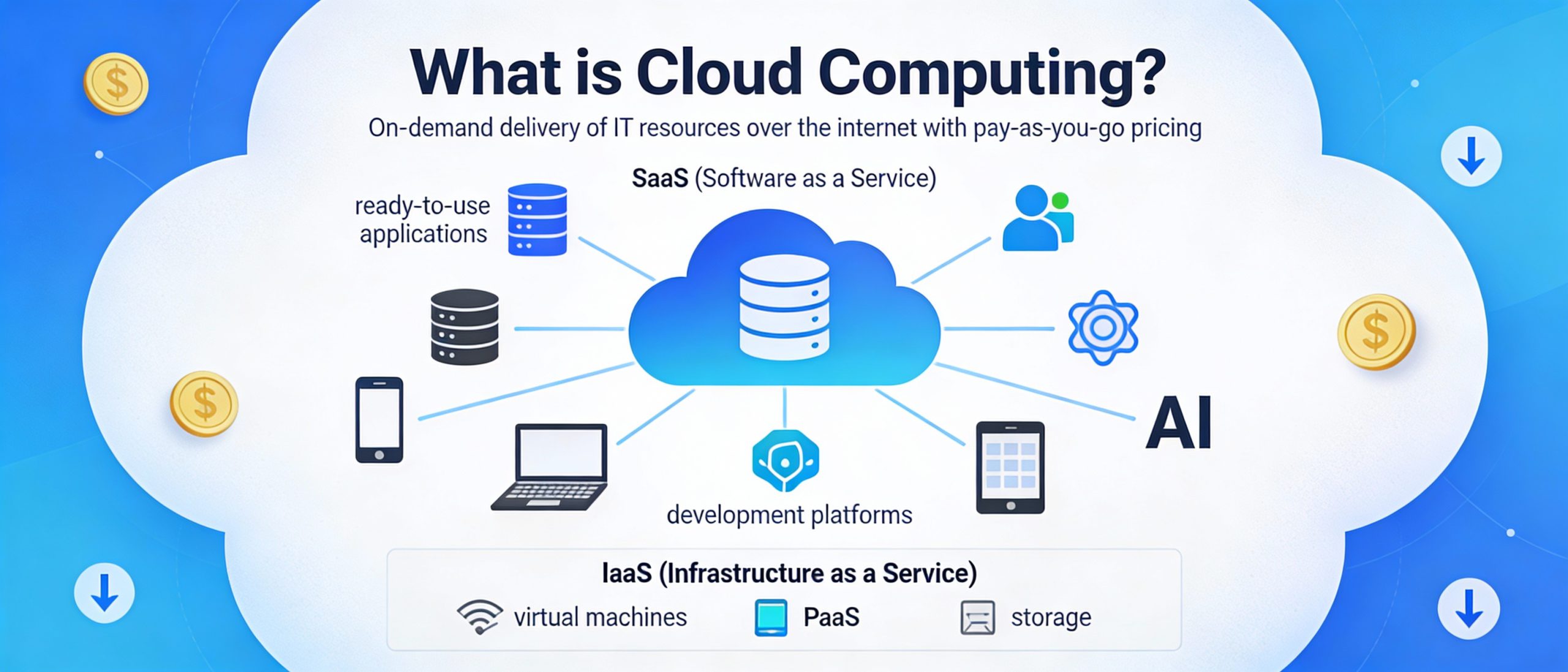
Cloud computing works through a network of remote servers located in data centers. These servers handle all computing tasks such as storing files, running applications, managing databases, and processing requests.
The working model is divided into three main service categories:
1. Infastructure as a Service (IaaS)
Provides virtual machines, storage, networking, and basic computing infrastructure.
2. Platform as a Service (PaaS)
Provides application development platforms, managed databases, and tools needed to build and deploy software.
3. Software as a Service (SaaS)
Delivers ready-to-use applications over the internet without installation.
These services are offered through different deployment models including public cloud, private cloud, and hybrid cloud.
Benefits of Cloud Computing
Cloud computing offers several advantages that make it more efficient than traditional IT systems:
- Lower operational cost
- No need for hardware maintenance
- Faster deployment of applications
- On-demand scaling based on workload
- High performance and availability
- Built-in security and disaster recovery
- Better collaboration through global access
- Support for modern tools like DevOps and AI
These benefits have made cloud computing a top skill for professionals who want to grow in IT.
Career Opportunities in Cloud Computing
Cloud computing skills open the door to a wide range of roles, such as:
- Cloud Engineer
- Cloud Administrator
- Cloud Solutions Architect
- DevOps Engineer
- Site Reliability Engineer
- Cloud Security Specialist
- Cloud Developer
- Data Engineer using cloud platforms
With companies actively shifting to cloud infrastructure, skilled candidates have excellent growth opportunities and competitive salaries.
Q&A: Common Questions About Cloud Computing
1. Is cloud computing suitable for beginners?
Yes. Cloud computing is beginner-friendly, and with proper training and hands-on practice, anyone can learn and grow in this field.
2. Do I need programming knowledge to learn cloud?
Basic programming helps, but it is not mandatory for all cloud roles.
3. Can non-IT students learn cloud computing?
Yes. Many learners from non-IT backgrounds build successful careers in this field with structured training.
4. Which cloud platform should a beginner start with?
Beginners can start with any major cloud platform. What matters most is understanding the core cloud concepts.
5. Is cloud computing a good career choice in India?
This field has strong job demand, excellent salary potential, and long-term career stability.
NareshIT – Delivering quality software training for over a decade. Empower your future with job-oriented courses and practical sessions